Time Alignment¶
Every sensor reading on a robot is a pair: what was measured, and when. The "what" gets all the calibration attention. The "when" is where the silent bugs live.
If two modules disagree on what "now" means by even a few tens of milliseconds, the data they produce no longer describes the same world. Downstream fusion and control still produce confident outputs — about a scene that never existed. Time alignment is the discipline of keeping that gap closed across every clock, timestamp, and processing delay on the robot.
The trickiest of these bugs live inside a single robot. The autopilot, mission computer, perception nodes, and sensor firmware each have their own clocks. None agree; none are wrong in their own frame.
1. Pick One Canonical Clock¶
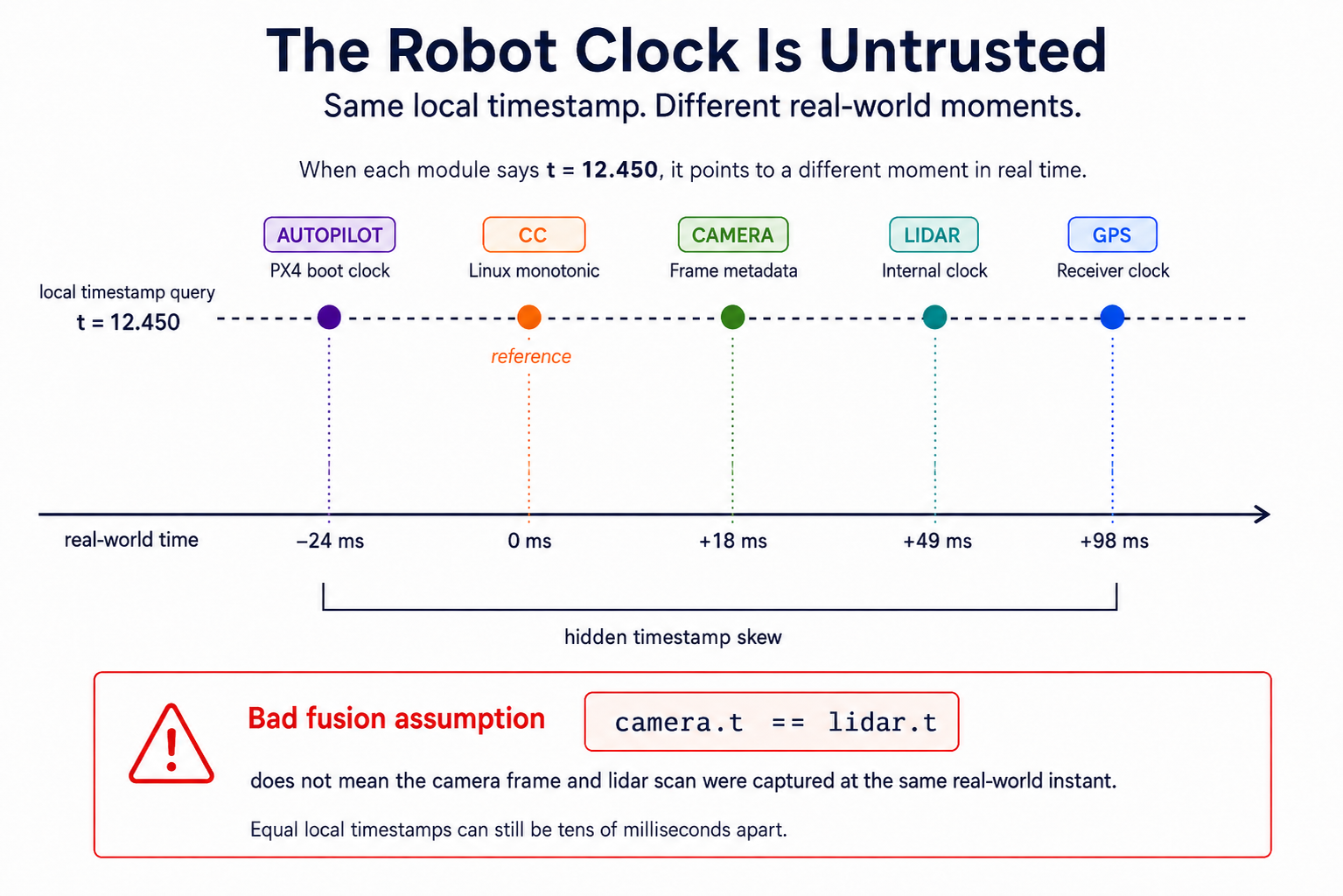
There is no "the robot's clock." A typical platform has four or five independent clocks: the autopilot's, the mission computer's, each camera's, the lidar's, and the GPS. Each starts at a different instant, drifts at its own rate, and is authoritative in its own frame.

The bug that costs you a flight: two modules both stamp their data with what they each call "t = 12.450", and a fusion node treats those as the same instant. The lidar and camera detections might be 80 ms apart in reality. The perception stack happily projects lidar points into a camera frame captured during a different part of the maneuver. The fused output looks reasonable. It's wrong.
The fix is the same boundary discipline from system design §2 and the adapter pattern in progressive testing: treat the timestamp as part of the sensor reading, and convert it at the adapter. Every message from a module with its own clock gets re-stamped into a single canonical robot time. Downstream code only ever sees canonical time. No fusion node ever asks "whose clock is this?" because the answer is always the same.
2. Reconcile By Measured Offset, Not By Hope¶
Re-stamping at the adapter only works if you know the offset between each module's clock and the canonical one. The wrong answers: assume it's zero, or measure it once at boot. Offsets drift. At 20 ppm, a clock loses a millisecond per minute, so a boot-time alignment is wrong by tens of milliseconds within an hour.
The standard fix is a continuous ping-pong, used by MAVLink's TIMESYNC and PTP's two-step:
companion → autopilot: "here is my t_cc = T1"
autopilot → companion: "I received it at my t_ap = T2, replying at my t_ap = T3"
companion receives reply at t_cc = T4
half_rtt = ((T4 - T1) - (T3 - T2)) / 2
offset_ap_to_cc = T2 - (T1 + half_rtt)
Run this every second, low-pass filter the result, and you have a continuously-updated "autopilot time minus companion time" that tracks drift. Each autopilot message gets its timestamp converted by adding that offset. Done well, the canonical frame stays accurate to the jitter of the link itself — sub-ms on UART, low-ms on USB, microseconds on PTP-capable Ethernet.
The same idea applies to every other module. The camera reconciles by triggering off a known signal and measuring the offset between "trigger fired" and "frame metadata says it fired." The lidar reconciles by wiring its PPS input to the GPS PPS and treating GPS-disciplined PPS edges as ground truth. Each adapter runs its own offset estimator.
A few things that catch people:
- Boot-time convergence. The first few seconds of data are stamped with whatever initial guess the estimator used. Either gate publishing until the offset stabilizes, or attach a confidence flag so consumers can decide.
- Re-stamping loses provenance. Always carry both timestamps: the original in the source clock, and the converted one in canonical time. Debugging a sync bug without the originals is nearly impossible.
- Don't re-stamp at publish. A planner that subscribes to a pose, runs for 30 ms, and publishes a trajectory stamped with
now()has lost the information about when its input was measured. Carry the source timestamp through; stamp publish time separately if you need it.
Characterization. Online, continuous, analytical. No bench tests, no per-unit calibration. The ping-pong runs at ~1 Hz forever, and the filter tracks slow drift while rejecting RTT spikes. Per-unit oscillator variance is absorbed automatically — the algorithm only tracks the running difference, so it doesn't care whether module A drifts at +18 ppm and B at -23 ppm. The only design choices are the filter constants and the boot-time gate.
Clock reconciliation is only half of the adapter's job. The other half — recovering when the measurement actually happened, not just when its message arrived — is the harder problem most teams skip.
3. A Detection Is Older Than Its Timestamp Says¶
Even after the clocks agree, the timestamp on a detection rarely says what you think. A camera detection at canonical t = 12.450 doesn't mean "an object was at this location at t = 12.450." It means "we finished computing a detection at t = 12.450, about a world that existed some time earlier." How much earlier is the difference between dodging an obstacle and reacting to where it used to be.
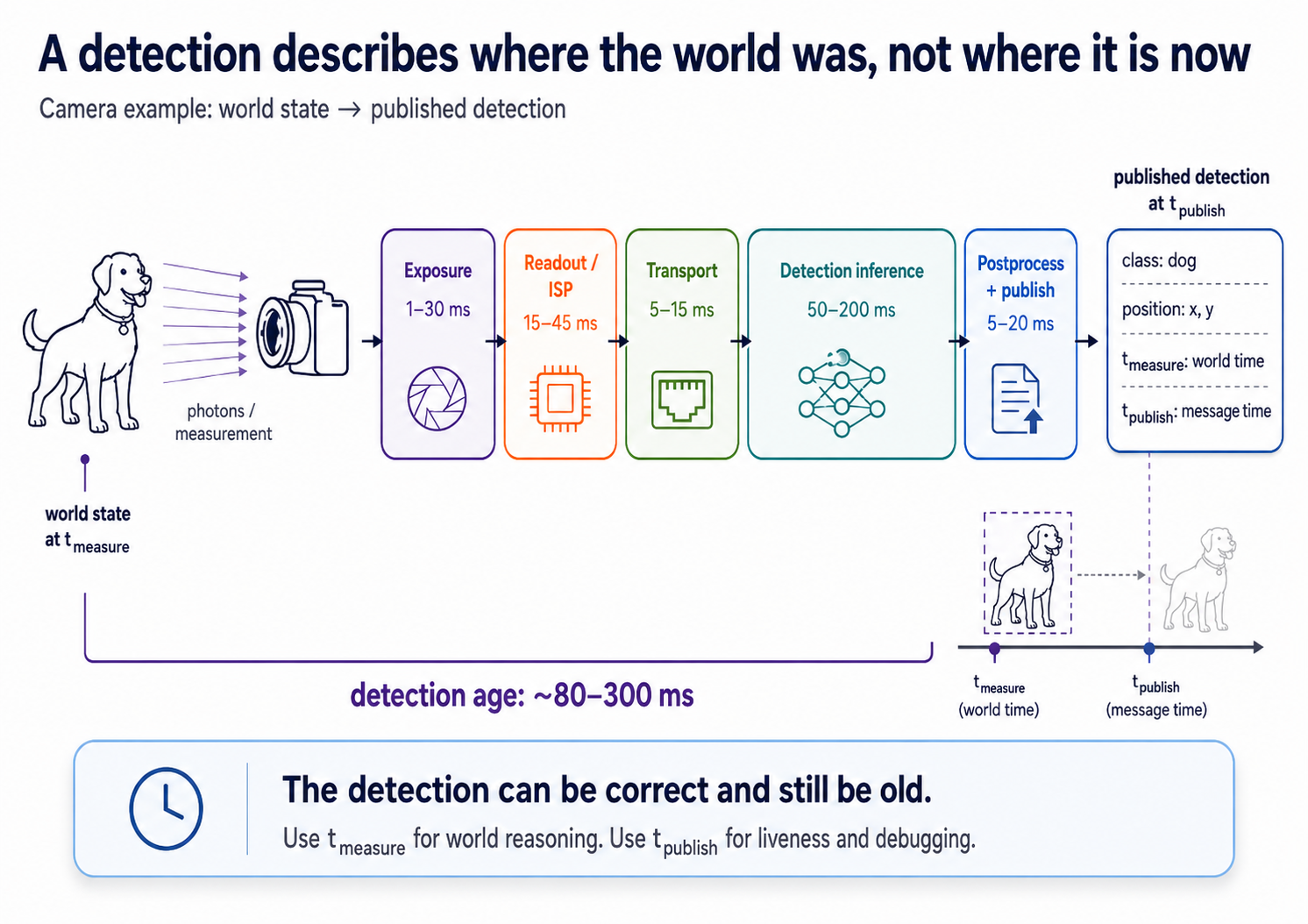
Every sensor pipeline costs time at every stage:

That total isn't theoretical. A detection arriving "right now" describes a world that existed 80–300 ms ago, depending on model and lighting. A controller that takes the timestamp at face value — even with perfectly reconciled clocks — reasons about an obstacle's location that's already wrong by however far the obstacle moved during the pipeline.
The fix is to put two timestamps on every message:
t_measure— when the world was in the state this message describes. Exposure midpoint for a camera detection; start-of-scan for a lidar frame; GPS fix epoch for a position update.t_publish— when this specific message was emitted. Useful for liveness checks ("haven't seen a detection in 200 ms"), network debugging, and ordering. Not for reasoning about the world.
Each adapter computes t_measure = t_publish - sum_of_known_stage_latencies. The latencies are measured per pipeline, not guessed. A camera with 20 ms exposure and 60 ms detection publishes with t_measure = t_publish - 0.080. If a stage's latency varies (say, inference time depends on scene complexity), the adapter measures it per-frame. If recovery is impossible, record an uncertainty band — not a confident-looking guess.
Spinning lidar: per-point, not per-message
A spinning lidar's points are spread across the scan — on a 15 m/s UAV, the platform moves 1.5 m during one 100 ms scan, so points acquired late in the scan are reported in a body frame the robot has already left. Motion-compensating the scan (re-projecting each point using the IMU trajectory across the scan window) is part of the adapter's job, not the planner's.
Once t_measure exists on every message, downstream code can finally do honest math. A planner extrapolates an obstacle's track forward from t_measure to "now" instead of treating a 200 ms-old position as current. A controller decides whether a detection is fresh enough to act on. A logger replays events in the order they happened in the world, not the order they hit the bus.
Characterization. Three layers, each measured directly:
- Software stages you control. Instrument with
t_in/t_outper node; the adapter sums them. Online, per-frame, tracks load variation for free. ROS 2 and MAVLink have hooks; add them if yours doesn't. - Sensor-internal stages (exposure, readout, ISP). Sealed, so you can't probe directly. Bench-flash an LED and histogram the arrival latency, or trust the sensor's embedded timestamp once §2 has reconciled its clock. In practice, both: embedded for the bulk, a bench offset for whatever the firmware misses.
- Per-unit variance. Ignorable for sensors (same-model units rarely differ by >5%). Actuators are the opposite. Motor response varies unit-to-unit, which is why PX4 stores motor time constants per vehicle. Sensors: per-model. Actuators: per-unit, at commissioning.
No ML — the structure is fixed, and direct instrumentation beats any learned estimator.
4. Reaction Loops Have An End-To-End Budget¶
Once every message carries t_measure, the next question is how stale is the freshest information the controller can act on? Every closed-loop reaction has a floor: photons hit the sensor, the pipeline runs, the planner reacts, the controller computes, the actuator physically responds.
A realistic obstacle-avoidance loop on a UAV:
| Stage | Latency |
|---|---|
| Photons → camera detection ready (§3) | 80–300 ms |
| Detection → planner (transport + queueing) | 5–20 ms |
| Planner inference (5 Hz nominal) | 20–100 ms |
| Trajectory → controller (transport) | 1–10 ms |
| Controller computation | 1–5 ms |
| Controller → ESC / servo | 5–20 ms |
| Motor / aerodynamic response | 50–200 ms |
| Total: photons → measurable response | ~160–650 ms |
At 15 m/s, a UAV covers 2.4–9.8 m during that window. That's the minimum standoff distance the system can guarantee against a static obstacle that appears suddenly. Anything closer is past the loop's ability to react, no matter how clever the planner is.
Three consequences fall out:
- The slowest stage sets the envelope. Doubling the controller's rate from 200 Hz to 1 kHz buys ~4 ms. Halving the detection model's inference from 200 ms to 100 ms buys 100 ms. Leverage lives in the dominant stage, and that stage is almost never the controller.
- Planners must extrapolate, not interpolate. The freshest detection is already 100–300 ms old, and the controller acts on it 30–100 ms later. A trajectory through "where the obstacle is now" actually targets where it was. Plan against the obstacle's projected position at the actuation moment, using
t_measureand a tracked velocity. - Reaction-time bugs hide in the slowest pipeline. If perception dominates at 250 ms and someone shaves the planner from 80 ms to 20 ms, total reaction time barely moves — but a casual review might claim "we halved planner latency" as if the robot were now twice as responsive. Budget the whole pipeline.
This ties back to system design's freshness budgets: every consumer publishes the maximum measurement age it tolerates, every producer publishes its actual end-to-end latency, and integration confirms the budgets close. When they don't, either reduce the slowest stage or widen the standoff envelope. Never pretend the loop is faster than the math allows.
Characterization. Compose the budget; don't measure it end-to-end. A synthetic-obstacle test that triggers a known event and times the response sounds rigorous, but it needs a controlled environment and just reproduces the §3 sum. Add the per-stage software and sensor numbers from §3, plus actuator response from airframe commissioning (motor time constants on a UAV, drivetrain response on a ground vehicle).
What you do measure across the loop is the distribution, and from logged flights, not bench tests. Over a representative mission, log every stage's t_in/t_out, sum per frame, and histogram the total. The 99th percentile is your design number, not the median. The median tells you what usually happens; standoff distances have to survive the bad frames, not the typical ones. A median of 200 ms with a 99th-percentile of 500 ms has a 500 ms budget — pretending otherwise is how you get a collision on the one frame the GPU stalled.
Re-characterize whenever you change a detection model, swap a sensor, refactor a hot path, or move to a different airframe variant. Re-log on a schedule even when nothing changed, because compute regressions silently widen the tail — background services waking up, thermal throttling mid-flight, OS upgrades quietly adding kernel work. Treat the 99th-percentile budget as a CI metric: if a software change widens it, you've regressed.
5. Characterize Cold, Loaded, Long, And Live¶
The Characterization blocks in §§2–4 say what to measure. They don't say under what conditions, and the answer is "all of them." Bench numbers from an idle robot are a starting point, not a finish line.
Four conditions, each revealing a different class of bug:
- Cold. One stage at a time, nothing else running. Establishes the floor — the latency the robot can hit when nothing competes, which is the latency it will never actually see in flight. Still useful as a sanity check: a stage that already eats half the §4 budget cold is something to fix before any later test is meaningful.
- Loaded. Everything on at once — GPU saturated with inference, every sensor streaming at full rate, motors spinning at flight-realistic current. Medians drift up a few percent; tails drift up a lot. A 200 ms median might load to 220 ms while its 99th percentile jumps from 280 ms to 600 ms. The loaded 99th is the real number §4 has to absorb, not the cold one.
- Endurance. Run the loaded system longer than a real mission. Thermal throttling, memory leaks, oscillator drift, growing middleware state, and slow disk I/O all widen the tail over time — and cold/loaded testing misses every one. Acceptance criterion: monotonic stability. If the tail is creeping upward over the run, there's a leak and the budget will eventually fail to close.
- Live. Once deployed, the same metrics become health signals. Each adapter reports its latency and timestamp statistics at 1 Hz, and watchdogs alarm when the running 99th percentile approaches the §4 budget, when a publisher goes stale, or when the §2 offset estimator's residuals grow. Catch degradation before the budget actually violates, so degraded modes have time to engage.
A system has a known healthy operating envelope only after it's been characterized under the conditions it will actually run in. Each skipped stage has a specific cost: skip loaded and load will kill you; skip endurance and a robot that demoed perfectly will fail on the first long mission; skip live and a slowly-failing sensor will produce confidently wrong outputs until something obvious breaks downstream.
6. The Middleware Owns Time, Or You Do¶
Everything covered so far — clock reconciliation, measurement-time recovery, end-to-end budgets — has to live somewhere in the stack. The framework you pick decides which pieces are handed to you and which you build yourself.

The chart shows what each side offers. What it doesn't show is where production teams end up after the §4 budget refuses to close.
ROS 2 gives you scaffolding, not a solution. The /clock abstraction and use_sim_time are genuinely useful for sim and replay — they hand you a pluggable time source the whole node graph respects. But production clock discipline (making the hardware clocks agree in the first place) is an OS-level concern: you configure PTP or NTP yourself, outside ROS, and ROS reads whatever the system clock says.
The Header.stamp convention exists, but nothing enforces it. A node that stamps with receipt time instead of measurement time compiles and runs silently — that's how most fusion bugs in ROS-based systems get written. tf2 and message_filters::ApproximateTimePolicy are real alignment primitives, but they solve the problem after timestamps are correct, not before.
The transport layer is where the budget breaks. Every ROS 2 message crosses a DDS serialization boundary, and every hop pays for it. Profiling shows up to 50% latency overhead compared to calling DDS directly; under load, with lidar and camera saturating the same DDS domain, the tail kills you.
Production teams converge on bypassing ROS 2 on the latency-critical path while keeping it for everything else:
- At the Indy Autonomous Challenge, the winning team (TUM) ran a lidar driver calling the DDS API directly beneath ROS 2, cutting transport latency by up to 90% without breaking compatibility with the rest of the stack.
- A study on a production L4 vehicle running Autoware Universe replaced intra-process DDS with a shared-memory transport (SIM) and saw perception-to-decision latency drop from ~522 ms to ~290 ms — enough to shorten emergency braking distance by four meters at 40 mph.
These aren't exotic workarounds. They're what closing a real §4 budget looks like.
Bare-metal (MAF) pays the opposite tax. Clocks are constructor arguments, t_measure is a required field rejected at the authority boundary if missing, and single-writer is enforced at link time. The time bugs ROS lets you write silently won't compile here. What it costs: no tf2, no message_filters, no bag replay, no package ecosystem. Every alignment primitive is yours to build, and the tooling gap is real.
Which trade? If the critical reaction loop has to close a tight §4 budget — collision avoidance on a fast platform, anything safety-critical — bare-metal earns its keep. If 50–100 ms of distributed overhead is fine and the ecosystem matters more, ROS is the right answer. Most production systems end up in the middle: ROS at the edges for tooling, visualization, and logging; bare-metal or a thin shared-memory transport on the latency-critical path from perception through control. The seam between them is where re-stamping into the right time model has to be most explicit, because crossing it means crossing time models too.
Assignment¶
Assignment under construction
This stub is a placeholder and hasn't been written yet. Check back later for content.